Listen & establish
Meet City and regional staff, review inherited Ward 10 files and establish the status of major projects. Give residents a clear route to raise concerns, with a reference number and a named office contact.
This material was prepared for the October 26, 2026 election. Proposals, promises and sample data below are historical campaign content—not current City plans, live case updates or an active first-100-days schedule.
Read my post-election message ↗PRIORITIES / THE WARD 10 ACTION PLAN
Responsible spending. Shorter, safer journeys. More places to belong. Clear steps residents can check.
October 2026 · Proposed actions if elected
START WITH FOLLOW-THROUGH
Establish the facts. Set the priorities. Report back.
These are proposed milestones after taking office.
Meet City and regional staff, review inherited Ward 10 files and establish the status of major projects. Give residents a clear route to raise concerns, with a reference number and a named office contact.
Publish initial neighbourhood priorities and supporting evidence. Request financial and service information for an efficiency review. Bring schools, community organizations and residents into discussions about road safety and local facilities.
Launch the public dashboard with a first action report, monthly resident office hours and quarterly progress updates. Project completion dates would follow staff advice, funding and approvals.
THE ACTION PLAN
Open a priority to read the commitments, the limits of the role and the measures that matter.
My goal is to work toward a property-tax freeze through sustainable, department-by-department efficiencies while protecting essential services. That means examining how money is spent and identifying savings that can continue year after year.
I will vote for an independent auditor to examine whether Mississauga spending delivers value for money. Council retained its internal audit model in March 2026; Peel now has an independent Auditor General. I would seek scrutiny of departmental spending, contracts, consulting, overtime and service performance. [6][7]
I would work with Mississauga, Brampton, Caledon and Peel to assess a shared independent audit service through Peel’s Auditor General, covering the Region and all three municipalities. This could reduce duplicated administration and specialist costs. I would request a public business case covering legal authority, costs, net savings and service capacity. Each council would need to approve the arrangement, with protected audit independence and findings reported publicly to each council. Savings must be demonstrated before restructuring.
A tax freeze must rest on recurring savings. I would scrutinize reliance on reserves, deferred repairs or costs shifted into future years. Libraries, recreation, roads, transit and public safety need reliable funding. Where savings are insufficient, I will explain the gap and choices rather than claim an unfunded freeze.
The property-tax bill combines City, regional and provincial education charges. I would pursue efficiencies through City and regional budgets and explain which portion each proposal affects. I cannot guarantee every component of a household tax bill. [2]
Departmental report cards should connect past decisions, present results and future risks. Did earlier spending deliver what was promised, and what should we learn? What problem are we solving now, and are costs, waiting times and delays improving? What future benefit could follow, and what expense or service failure could we prevent? I would seek budget-versus-actual reporting, comparisons of alternatives, and published recommendations with a responsible department and follow-up date.
verified annual savings after implementation costs; service standards maintained; audit recommendations completed; capital projects delivered against their approved budgets and schedules.
Time spent stuck in traffic is time taken away from work, school and family. At the same time, residents need to feel safe crossing a road, walking to a bus stop or letting their children travel to school. I want shorter, more reliable journeys and safer streets for everyone using them.
My approach would start with specific locations and evidence: where delays build up, when speeding occurs, which turns or crossings feel unsafe and what changes could realistically help. Each priority should have a responsible road authority, a proposed next step and a way to measure the result.
I would request a ranked review of reported hotspots on Tenth Line, Britannia and Ninth Line, alongside school routes and neighbourhood streets identified by residents. Residents’ experience should be considered with traffic volumes, travel times, collision records, speed studies, crossing conditions and reported near misses.
The public list would explain why each location is a priority, what information is still needed, which authority is responsible and when a response or review is expected. It should distinguish between maintenance issues, operational changes and larger projects that require design work, funding or approval.
I would ask staff to examine signal timing, coordination between intersections, turning movements and recurring queues on priority corridors. Changes should be assessed across the route so that improvements at one intersection do not simply move the delay to the next.
I would seek a costed pilot of coordinated or adaptive traffic signals on a suitable corridor, using real-time traffic data where appropriate. Before starting, the pilot should establish peak-hour travel times, bus reliability, pedestrian waits and safety measures. Results and operating costs should be published before any decision to expand.
I would bring residents, schools, trustees and transportation staff together to review difficult crossings, turning conflicts, visibility, accessibility and pickup or drop-off conditions. Children, seniors and people using mobility aids should be considered in the assessment.
Depending on the location, staff should assess crossing times, sightlines, signs, markings, parking restrictions, traffic calming and road design. Where crossing-guard coverage is raised as a concern, I would request a review against the applicable criteria. Proposed changes should identify costs, responsibilities and effects on nearby streets.
I would take documented speeding and dangerous-driving patterns to City staff and Peel Police, asking for responses at the times and places supported by the evidence. Enforcement should be considered alongside street design, visibility and traffic-calming options where appropriate.
Follow-up matters: were speeds reduced, did the change last and did traffic shift onto another residential street? Police deployment would remain an operational decision for the Chief. The neighbourhood-safety plan sets out the wider approach to coordinated enforcement and prevention. [5]
I would ask MiWay and transportation staff to identify where buses lose time and where unreliable connections make journeys difficult. Transit signal priority and practical improvements to stop access, crossings and connections should be assessed where they could make a measurable difference.
Proposals should show the expected benefit to passengers, the effect on other road users and the cost. The aim is to help more people reach their destination reliably, with results measured across the whole journey.
I would track Ninth Line improvements and approved Churchill Meadows Boulevard traffic calming against the City’s published commitments. Residents should receive clear updates on milestones, disruption, changes to access and reasons for delays. Once work is complete, I would request a review of whether it delivered the intended improvement. [3][4]
In the first 30 days, I would request existing traffic studies, review active projects and gather residents’ priority locations. By day 60, I would publish an initial list for feedback and ask staff to identify feasible options. By day 100, I would publish the first Traffic Action List, with responsibilities, available cost estimates, outstanding decisions and follow-up dates.
A place on the list would be a commitment to pursue and report on the issue. Construction and implementation dates would depend on technical review, budgets and approvals.
Peak-hour travel times and reliability; bus journey times; speeds and crossing conditions; collisions over a meaningful period; completed improvements; and whether problems recur or shift to nearby streets. Before-and-after comparisons should account for school terms, construction and other changes that could affect the results.
Parents need places their children can use after school. Teenagers need welcoming places to spend time. Seniors need accessible activities and connection. I want more “third spaces”: safe, affordable places beyond home, school or work where neighbours can meet without having to buy something.
I would request a review of peak-hour bookings, public access, waiting lists and unused capacity at local recreation facilities. The aim is to identify where dedicated community-use hours and affordable drop-in sessions could work alongside existing programs and leagues. Proposed changes should explain the effect on current users and revenue.
I would work with recreation staff, libraries, trustees and youth non-profits on supervised sports, arts, tutoring and homework support, using existing community space. Youth should help shape the activities and welcoming drop-in hours.
I would establish advisory councils bringing together students and children of different ages. Through schools and community partners, I would seek broad participation, including young people who are often missed. With age-appropriate guidance, they could propose priorities, help design and lead suitable activities, and receive a public response to their recommendations.
I would work with seniors’ organizations and youth partners on a voluntary Adopt a Grandparent pilot: regular, supervised opportunities to read, share stories, learn skills and build friendships. Partners would arrange appropriate screening, parental consent for minors and safeguarding. Seniors and families would help shape the format, accessibility and transportation needs.
I would also support accessible, free or low-cost activities for seniors and partner-led seasonal gatherings, such as summer movie nights and winter community activities, where venues, staffing and funding can be arranged.
In year one, I would bring forward costed pilot options using existing space. Each must identify a delivery partner, staffing, safe participation, hours and funding. Free to attend still has a cost; expansion would depend on participation, feedback and an affordable operating budget, supported by existing funds, grants or suitable sponsorship.
public access hours, participation and repeat attendance, waiting lists, cost per participant, accessibility feedback and whether residents feel the activities meet their needs.
Everyone should feel comfortable walking home, letting their children use a park, visiting local businesses and enjoying their neighbourhood. Residents should also know that when they report a recurring problem, someone will take responsibility for following it through.
My approach combines practical crime prevention, properly supported frontline policing, targeted enforcement and stronger relationships between neighbours. Each initiative should have a clear purpose, a responsible partner and a way to assess whether it is working.
Speeding, dangerous driving, excessive noise, illegal parking and blocked access can become persistent problems when complaints are handled separately. I would ask City enforcement staff and Peel Police to review recurring locations together, using residents’ reports alongside available incident and enforcement data.
The goal is to identify when problems occur, which agency can address them and what follow-up is needed. I would advocate for enforcement at the locations and times supported by the evidence, then ask whether conditions improved and whether the problem returned. Police deployment would remain an operational decision for the Chief. [5]
Lighting, visibility, access and maintenance deserve attention before a location becomes a recurring concern. I would work with City staff, Safe City Mississauga, Peel Police and property owners to prioritize Crime Prevention Through Environmental Design assessments around parks, pathways, community facilities and commercial areas.
Assessments should lead to an action list: what needs fixing, who owns the property, who can authorize the work, what it would cost and when a response is expected. Where larger changes require funding, residents should be able to see the proposed options and reasons for delay.
Residents, landlords, tenants, businesses and property owners all have a role in keeping neighbourhoods welcoming and well maintained. I would propose a practical framework that makes expectations clear, helps resolve problems early and seeks consistent follow-through when violations continue.
This would include:
The focus would be on conduct and evidence. Residents should not have to confront someone to receive help, and complaints should be assessed fairly, with personal information protected.
I support properly funded frontline policing. I would seek clear reporting on response times, staffing, overtime and service pressures, and ask how additional spending translates into better service. Residents deserve an explanation of both the resources required and the results those resources are intended to deliver.
I would explore noise-detection technology and crime-prevention cameras only where a defined problem and supporting evidence justify consideration. Before any pilot, I would seek a public explanation of its purpose, lawful authority, less intrusive alternatives, full costs and privacy safeguards.
That review should address what is recorded, who can access it, how long it is retained and how misuse would be addressed. Any pilot should have a defined duration and published evaluation criteria. Expansion should depend on demonstrated benefits.
In the first 30 days, I would request a review of recurring safety concerns and outstanding prevention assessments. By day 60, I would publish proposed priorities and bring residents, businesses and relevant agencies into discussions about the Good Neighbour Plan. By day 100, I would publish an initial action report identifying responsibilities, requested actions, available cost estimates and follow-up dates.
Progress should be judged by safer access, completed improvements, fewer recurring problems and residents’ experience—not simply by the number of meetings held or tickets issued.
LOCAL ISSUES / NAMED RESPONSIBILITIES
These issues need named responsibilities and sustained follow-through. I would put both plans on the public dashboard, publish quarterly updates and hold resident meetings to review results.
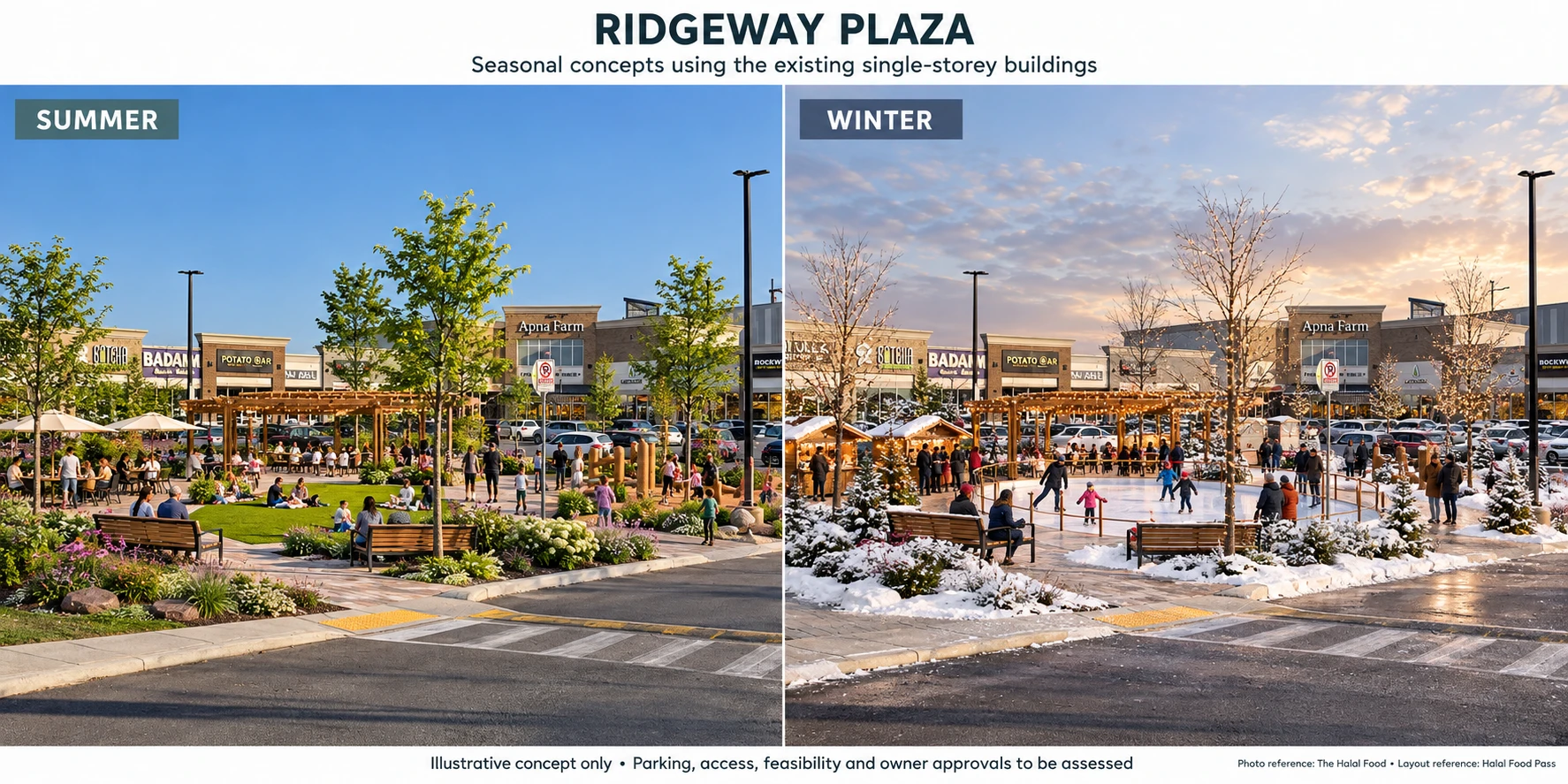
Meet nearby residents, businesses, plaza owners, City enforcement and Peel Police. Review delivery of the April 2026 compliance and security agreement, including privately funded security, access controls and the City’s parking enforcement commitments. Identify unfinished actions and recurring problems. [8]
Seek a coordinated response plan for dangerous driving, noise, illegal parking, litter and blocked access. Publish responsibilities, actions and follow-up dates; police retain operational control. I would also explore an owner-supported green gathering space with safe pedestrian access. The concepts above illustrate a possible summer and winter gathering space.
Publish progress against the agreement and request corrective action where problems persist. Measure repeat complaints, response times, safe access and residents’ and businesses’ feedback, alongside enforcement activity.
Operating status.
Remaining work.
Performance in storms.
Request station-by-station updates, costed options to accelerate protection and public follow-up after major storms.
No plan can promise zero flood risk.
Request a public, station-by-station update on Lisgar’s foundation drain collector pumping program: what is operating, what remains, budgets, milestones and reasons for delay. Ask staff to confirm maintenance, monitoring, backup arrangements and emergency response responsibilities.
Bring residents, City stormwater staff and Peel together to review outstanding risks and the next work program. Request costed options to accelerate remaining protection where feasible. Review the downspout disconnection pilot, whose published construction target is summer 2027, and whether earlier delivery is practical. [9]
Publish milestones and request results on rainfall, water levels, pump operation and reported flooding. Collect residents’ damage photographs, dates and documented losses with consent, keeping household details private. Compare similar storms, identify corrective work and publish follow-up dates.
If municipal and regional options cannot provide adequate protection, I would take the evidence to our MPP and MP and seek provincial and federal technical assistance and funding. I would request written responses and report next steps while continuing to press for local delivery. No plan can promise zero flood risk.
ACCOUNTABILITY YOU CAN CHECK
Residents should be able to compare promises with decisions and results. I would publish each commitment, the responsible office, target date, budget and spending to date where available, current status and next step. I would link relevant council votes, show how I voted and explain why. Delays, changed targets and unmet commitments would stay visible, with reasons and a dated update history. This gives residents evidence to question elected officials and judge my record. Personal case details would remain private.
Explore the sample dashboard →The existing dashboard is an illustrative sample, not a live record of completed commitments.
READ / PRINT / SHARE
Read the detailed proposals above, or download the five-page Ward 10 action plan to keep and share.
Tell me which local concern needs attention and what a useful result would look like.
These are the public references used in the October 2026 action plan. Project targets should be checked against subsequent City updates.